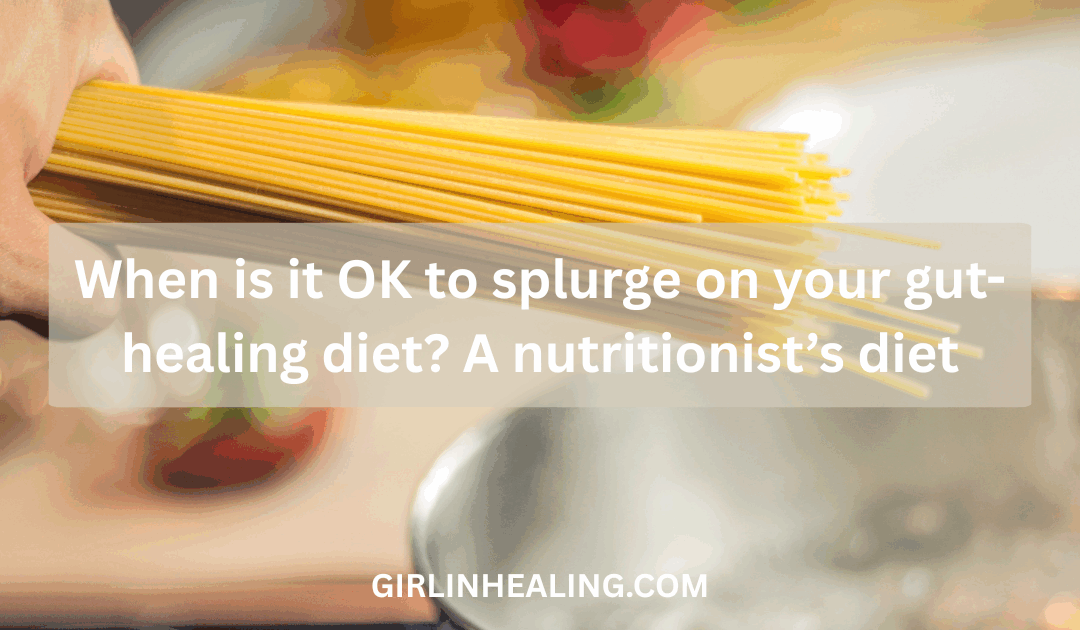
So you’re following certain eating guidelines to heal your gut and reduce uncomfortable symptoms like bloat, urgency, gas,and more. You’re wondering, “When is it OK for me to indulge in a food that may or may not trigger me?” I got you.
Maybe you’re on vacation and you’re wondering if you can have a bite of gluten. Or maybe it’s the summertime and you’re wondering if that cup of vanilla ice cream will be the best or worst decision of your summer.
As a nutritionist who specializes in gut health issues, including inflammatory bowel disease (IBD) and IBS, these are the guidelines I recommend to clients and have also used personally in my own experience with Crohn’s.
When not to indulge on your gut-healing nutrition plan
If you were just diagnosed with Crohn’s, ulcerative, colitis, IBS, etc. or if you just started your gut healing plan
I fully believe in being as least restrictive as possible on any healing journey in order to not make healing unnecessarily hard on yourself and to expand nutrient diversity. However, it’s imperative that you give healing protocols time to work. They involve removing trigger foods; foods you’ve likely been eating regularly for a long time. Your body is going to need an extended break from some of these foods in order to begin the healing and sealing process in the gut. At minimum, this is about a month. Depending on the severity of your symptoms, it may be two or three months that you want to be strict on your protocol.
If you’re symptomatic or in a flare-up
It might sound obvious, but if you’re living with noticeable, regular symptoms daily or you know you’re in a full-on flare-up, this is not the time to reintroduce a food, especially one that is indulgent and more likely to trigger symptoms.
Avoid the “I already don’t feel well so I’m going to eat whatever I want,” mentality. All this tells yourself subconsciously is that you’re willing to give up on yourself you’re willing to give up on yourself. If you want your body to behave predictably, you need to demonstrate that you’re able to commit to what you say.
If you want to indulge in a food because you’re feeling resentful, left out, or something else emotionally charged
I have done this and have been upset with myself later. Save yourself the feeling of frustration and “being setback,” (even though that’s not entirely true). When you’re considering eating out of emotions, commit to pausing for 30 seconds. Take your focus off of the food and turn inwards. Ask yourself, “What am I really feeling in this moment?” you’ll likely find there is an emotion attached to it that is not simply wanting to eat the food.
If you decide to indulge
And you meet these qualifiers,
- Are not symptomatic or flaring
- Are not within the one-month range of your gut-healing protocol
- Are not eating an indulgent food out of an emotional reason
- You truly want to taste the food and you feel well
Then it may be a safe time to try that food.
Keep these things in mind if you decide to indulge
Quantity matters
It’s easy to get over-excited about a treat or nostalgic food that you decided you feel good about trying. One serving can become many, and while one serving may not cause a lot of GI distress, three might do the trick.
Be fully present when you’re going to indulge in a food. Use all your senses. See it, smell it, savor the taste, and chew slowly. When you’re present while eating, you’re less likely to overdo it.
Be prepared to support your body after
Sometimes the food we introduce or indulge in doesn’t go as well as we hoped. I always tell my clients that this is simply data. It doesn’t mean you’re bad or wrong. The experience gave you data about where your body is in relation to tolerating that food.
But just in case this happens, it’s good to have a toolbox ready to support your body.
I personally always keep a binder, probiotic, and a couple of herbal/soothing supplements in my medicine cabinet. It would be wise to also take a digestive enzyme with the indulgent food, if that isn’t already part of your gut-healing protocol. You can see my recommended supplements for IBDgut-health supplements for IBD/gut-health here and create an account for free on my Fullscript dispensary, where you’ll always get an extra discount on the top-quality supplements.
Herbal teas like peppermint, ginger, fennel, chamomile, etc. also do wonders for the gut as well as warm lemon water (my all-time favorite gut health trick).
Remember
- There’s no place for guilt or shame whether we’re removing foods are indulging. This is simply about healing and making the best choice for your body.
- Less than ideal experiences with food are simply just data.
- A food that doesn’t work for you now could in the future.
- You don’t have to navigate this alone. Working with a gut health professional will support you through these ins and outs of eating and gut healing. You can book a free call if you’re curious about joining my practice.
If you have experience balancing you got healing diet with indulging comment on the post and let me know your thoughts.
P.S. If eating in general is super confusing and frustrating, you need my e-book that has no health hundreds of people navigate eating with IBD and got issues.